Introduction
AI marketing automation has become a foundational pillar of modern digital marketing strategies. In 2026, brands that lead their industries are not simply using automation to save time; they are leveraging artificial intelligence to predict behavior, personalize experiences at scale, and optimize marketing decisions in real time.
This article provides a detailed analysis of brands winning with AI marketing automation, supported by real case studies, clear use cases, and measurable business outcomes. These examples highlight how AI-powered marketing automation drives revenue growth, customer engagement, and long-term brand loyalty.
The Role of AI Marketing Automation in Modern Digital Marketing
Traditional marketing automation relies on fixed rules and predefined customer journeys. AI marketing automation, on the other hand, uses machine learning, predictive analytics, and behavioral data to continuously improve outcomes.
Key capabilities include:
- Real-time customer data analysis
- Predictive intent modeling
- Dynamic content personalization
- Automated optimization across channels
- Continuous performance learning
This shift allows brands to move from reactive marketing to predictive and proactive customer engagement.
Case Study 1: Amazon – AI-Driven Revenue Growth Through Hyper-Personalization
Business Challenge
With millions of products and global customers, Amazon needed a way to deliver highly relevant experiences without manual segmentation.
AI Marketing Automation Implementation
Amazon’s AI systems automate personalization across:
- Product recommendations on the website and app
- Trigger-based email campaigns
- Dynamic pricing and cross-selling suggestions
AI models analyze:
- Browsing history
- Purchase patterns
- Time spent on product pages
- Similar customer behavior
These insights automatically shape what each customer sees in real time.
Measurable Impact
- Over 35% of total revenue attributed to AI-powered recommendation engines
- Significantly higher conversion rates from personalized emails
- Increased average order value through intelligent cross-selling
Strategic Insight
Amazon proves that AI personalization is not a feature—it is a revenue engine. Continuous learning models outperform static customer segments.
Case Study 2: Starbucks – Predictive AI Marketing for Customer Loyalty
Business Challenge
Starbucks aimed to increase repeat visits while maintaining relevance across millions of loyalty members.
AI Marketing Automation Strategy
Starbucks integrates AI into its loyalty ecosystem to automate:
- Personalized offers
- Push notifications
- Email and in-app messaging
AI evaluates multiple contextual signals such as:
- Purchase frequency
- Location and time of day
- Seasonal preferences
- Past offer responses
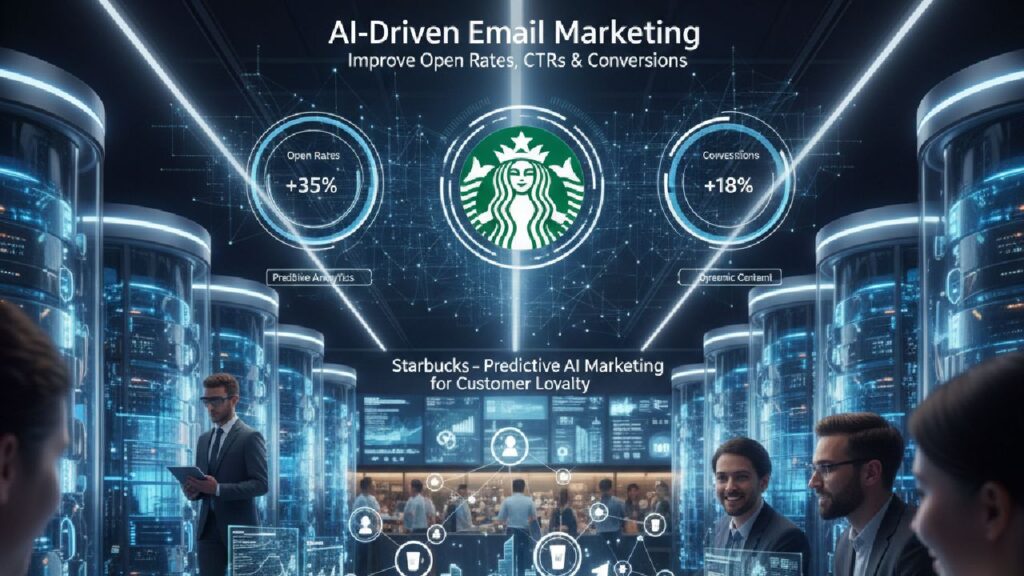
Based on predictions, the system automatically delivers the most relevant message at the optimal time.
Measurable Impact
- Higher loyalty program engagement
- Increased customer lifetime value
- Improved redemption rates on personalized offers
Strategic Insight
Predictive AI marketing transforms loyalty programs from reward systems into behavior-driven engagement platforms.
Case Study 3: Netflix – AI Automation for Engagement and Churn Reduction
Business Challenge
Maintaining user engagement and reducing churn in a subscription-based business.
AI Marketing Automation Strategy
Netflix uses AI to automate and personalize:
- Content discovery recommendations
- User interface layouts
- Thumbnail images and previews
AI continuously tests variations and learns which content keeps each user engaged longer.
Measurable Impact
- More than 80% of viewing activity driven by AI recommendations
- Reduced churn through highly personalized content experiences
- Increased session duration per user
Strategic Insight
Netflix demonstrates that AI-driven content personalization is a core retention strategy, not just a UX improvement.
Case Study 4: Sephora – Omnichannel AI Marketing Automation
Business Challenge
Delivering a seamless customer experience across digital and physical touchpoints.
AI Marketing Automation Strategy
Sephora uses AI to automate:
- Personalized product recommendations
- Email and mobile app campaigns
- Virtual try-on experiences using AI and AR
Customer data from online browsing, in-store visits, and app interactions feeds into a unified AI system.
Measurable Impact
- Approximately 30% increase in online sales
- Improved engagement across channels
- Reduced product returns due to better purchase confidence
Strategic Insight
AI marketing automation enables true omnichannel personalization, aligning digital convenience with in-store expertise.
Case Study 5: Small Business Example – AI Email Marketing Automation

Business Challenge
Limited resources and low performance from generic email campaigns.
AI Marketing Automation Strategy
Using AI-powered platforms, the brand automated:
- Customer segmentation based on behavior
- Abandoned cart and re-engagement flows
- Subject line and send-time optimization
AI continuously refined messaging based on performance data.
Measurable Impact
- 36% of total revenue generated through automated email flows
- 35x ROI on AI-driven email marketing
- Higher open and click-through rates
Strategic Insight
AI marketing automation levels the playing field, allowing small businesses to compete with enterprise-level personalization.
Core AI Marketing Automation Tactics Used by High-Performing Brands
Predictive Customer Segmentation
AI groups customers dynamically based on real-time behavior rather than static demographics.
Behavioral Trigger Automation
Campaigns launch automatically based on actions such as browsing, cart abandonment, or inactivity.
AI-Powered Content Optimization
AI tests headlines, creatives, and formats to identify what performs best for each audience segment.
Continuous Performance Learning
AI systems improve outcomes over time without manual intervention.
Benefits of AI Marketing Automation for Businesses
- Higher conversion rates through personalization
- Improved customer retention and loyalty
- Reduced marketing operational costs
- Faster decision-making based on real-time data
- Scalable growth without increasing headcount
Final Thoughts: Why AI Marketing Automation Is a Competitive Advantage
The brands highlighted in these case studies demonstrate that AI marketing automation drives measurable, sustainable growth. From global enterprises to small businesses, AI enables marketers to deliver smarter, faster, and more personalized experiences.
In 2026, brands that fail to adopt AI-powered marketing automation risk falling behind competitors who can predict customer needs, automate engagement, and optimize performance at scale.